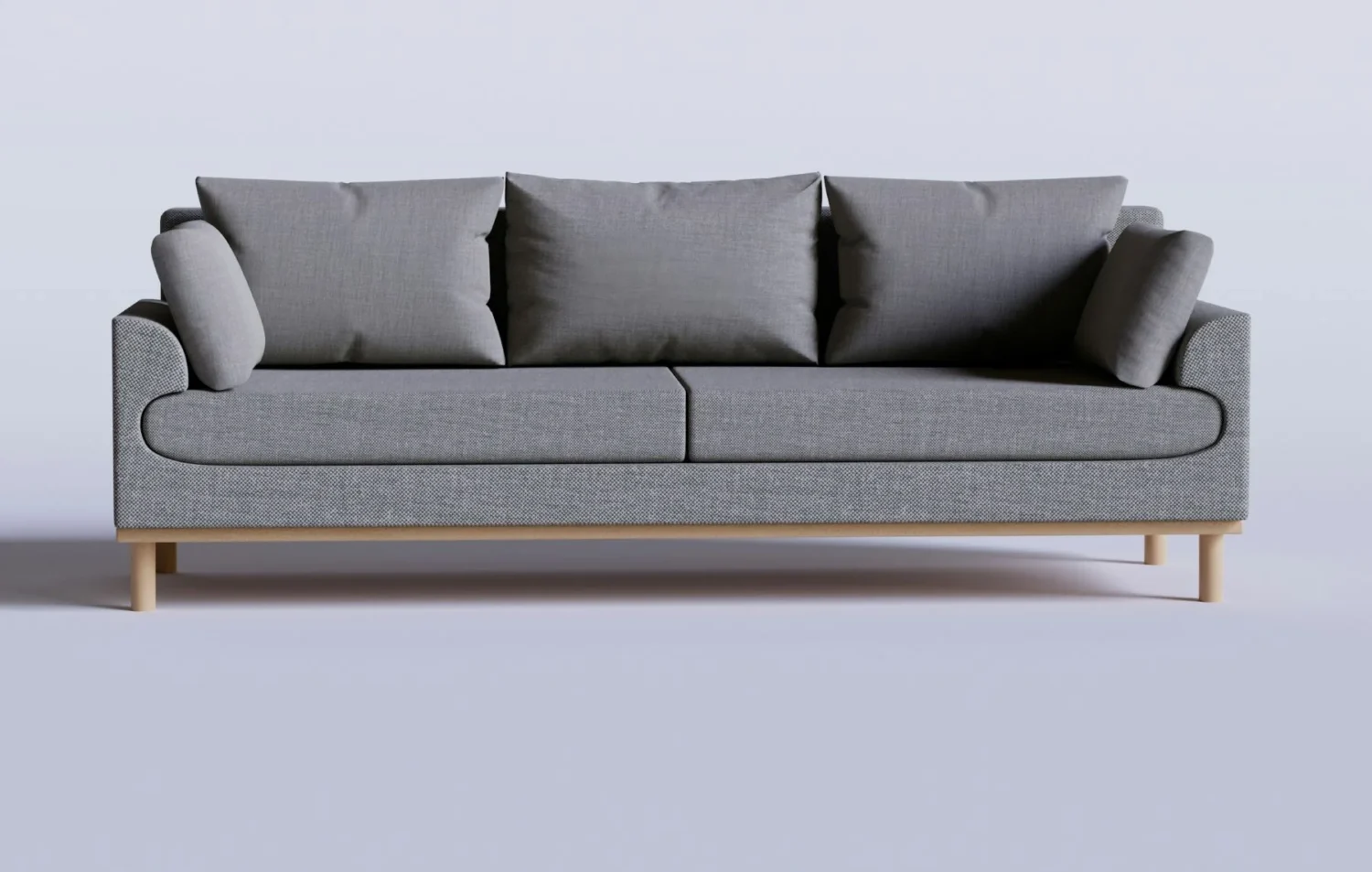

I once walked into a renovated guest suite with linen textures and brass hardware and sat on the sofa. It looked perfect. Then the owner opened the bed, and within seconds I could feel the support bar through the mattress.
That is the gap many guest rooms miss. A sofa bed can look refined and still fail at the only job guests remember, sleep.
A pull-out sofa bed has to work in two modes. It must seat well every day, then open smoothly and support an adult for several nights without sore hips, shoulders, or backs.
Use these checks before you buy:
– A mechanism that allows a real mattress
– Mattress depth that prevents bar feel
– Frame, foam, and fabric specs suited to Australian use
– Clearances for doors, walkways, and open-bed length
– A fast showroom test you can run yourself
– Material choices that reduce wear and indoor air issues
What Quality Means in a Pull-Out Sofa Bed
Quality is the sum of the frame, mechanism, mattress, upholstery, and room fit.
Price alone does not tell you much. A quality model uses a rigid frame, a mechanism that opens without twisting, a mattress deep enough to cushion the deck, and upholstery that stands up to daily friction.
The bar-in-back problem usually starts with a tri-fold mechanism and a thin mattress stretched over metal supports. Bi-fold pull-outs unfold in two sections, which leaves room for a thicker sleep surface. Click-clack and futon styles save space, but they usually give up mattress depth.
Two terms are worth knowing. Martindale, defined under ISO 12947, is a rub test that helps match fabric to use intensity. Foam density, measured in kilograms per cubic metre, shows how much material is packed into the cushion and how well it is likely to hold shape. Density is not firmness, so a dense foam can still feel soft.
The Three Big Decision Drivers: Comfort, Durability, Footprint
Most buying mistakes happen when one of these three drivers is ignored.
When owners regret a sofa bed, the miss usually sits in comfort, durability, or footprint. Get all three right, and the rest of the room is easier to solve.
Comfort
Bi-fold mechanisms usually allow mattresses around 12-13 cm thick. That depth suits most adults and helps prevent the metal-through-foam feel that makes sofa beds infamous. Pocket springs improve airflow and rebound, memory foam contours to pressure points, latex feels springier and cooler, and hybrids mix two or more traits. Tri-folds and futons can work for occasional teen guests, but they are a weak choice for adults staying several nights.
Durability
CHOICE notes that kiln-dried hardwood reduces future warping and can add about five hundred dollars to the price. That premium is not wasted if the sofa stays square, quiet, and stable for years. For seat cushions, Australian foam suppliers commonly point to high-resilience foams in the 31-36 kg/m3 density range for durable daily seating. Pair that with upholstery rated above 25,000 Martindale rubs, and you have a sofa that can handle repeated use.
Footprint
An Australian queen mattress measures 153 by 203 cm, and many queen pull-outs extend to roughly 226-230 cm when open. YourHome recommends internal door clear openings of at least 820 mm and passageways around 1000 mm, which matters on delivery day as much as it does in daily use. If the sofa fits the wall but the open bed blocks a robe, bathroom path, or terrace door, the layout still fails.
What To Specify: The Checklist the Trade Respects
A written spec keeps sales talk focused on details that matter.
Use this list when briefing a retailer, designer, or upholsterer. It turns a vague request for a nice sofa bed into a clear set of decisions you can compare across models.
– Mechanism: Choose bi-fold for regular adult guest use. Open and close it twice in store. Check for wobble, pinch points, and whether one person can manage it without strain.
– Mattress: Aim for 12-13 cm where space allows. Match the core to the guest profile. Pocket spring breathes well, memory foam contours, and latex rebounds quickly and sleeps cooler.
– Frame: Ask whether the hardwood is kiln-dried, or whether the frame uses high-grade plywood. Confirm corner blocks, cross rails, joinery method, and the frame warranty period.
– Seating Foam: Use high-resilience foam in the 31-36 kg/m3 range for seat cushions. Back cushions can be softer, but the seat should not bottom out when you sit down hard.
– Upholstery: For heavy domestic use, ask for 25,000-plus Martindale rubs and AS/NZS 1530.3 flammability data. Tight weaves usually hide wear better than open weaves or delicate pile fabrics.
– Dimensions: Record closed width, closed depth, open length, arm width, and mattress size. Check that standard fitted linen will work without endless slipping or bunching.
– Delivery and Warranty: Confirm whether arms or legs remove for access, who handles stairs or lifts, and how the warranty is split across frame, mechanism, mattress, and fabric.
For air quality and sustainability, shortlist FSC-certified timber where possible. Check that engineered panels meet E0 or E1 emission classes under AS/NZS 1859.2. GECA certification is also useful, because it points to stricter formaldehyde and material standards than a generic eco claim.
Australian Sizing And Space Planning
Plan the room around the bed when it is open, not the sofa when it is closed.
Australian standard sizes are simple but easy to ignore in a small room. A double is 138 by 188 cm, and a queen is 153 by 203 cm. A typical queen pull-out extends to about 226-230 cm when fully open. Everyday walking clearances should sit around 600-800 mm, while accessible layouts work better with roughly 900-1000 mm on at least one side.
Seat ergonomics still matter when the bed is folded away. A seat height of about 430-460 mm and a seat depth of 530-560 mm suits most adults. Test the sofa with the actual back cushions and scatter cushions in place, because extra padding can change both posture and comfort.
The Fifteen-Minute Showroom Test Script
Fifteen minutes in the showroom can save years of regret.
Bring a tape measure and use the same routine on every model.
1- Open and close it twice. Listen for grinding, creaking, or metal-on-metal scrape. Check how much force the mechanism needs and whether the frame wobbles at full extension.
2- Lie down for three minutes. Start on your back, roll to one side, then move toward the edge. Feel for bars, ridges, gaps, and weak edge support.
3- Sit in sofa mode. Try two sitting positions. Your feet should touch the floor comfortably, and the seat should support your thighs without making you slump.
4- Ask for the fabric and foam specs. Record the Martindale rating, seat foam density, and flammability data. If staff cannot provide basic numbers, treat that as a warning sign.
5- Measure the open footprint. Write down the open length, width, and wall clearance needed behind the sofa. Take a photo of the tape measure so you do not rely on memory.
6- Confirm logistics. Ask about removable parts, lead times, delivery access, and warranty exclusions. If the piece is for a coastal home or rental, ask how the materials handle sun, salt, and heavier turnover.
Where to shop and test in Australia
Before you order, try to handle the exact mechanism and mattress in a showroom, then compare the feel with the spec sheet. If you cannot visit in person, ask for a short video of the open-and-close action, the mattress depth, and the warranty details so you can check comfort and logistics without guesswork.
If you are in Queensland and want to test the mechanism in person, start by calling ahead, then spend ten minutes opening and closing the frame, checking mattress depth, and measuring the open length against your room plan. For a Brisbane or Gold Coast guest suite, if you are after a quality pull out sofa bed, prioritise bi-fold hardwood frames with a 12-13 cm mattress, verify Martindale ratings, and confirm delivery access before ordering.
Materials That Last In Australian Homes
Good materials feel better on day one and hold up better by year five.
Frames should use kiln-dried hardwood or well-made structural plywood, not light timber that twists under load. If engineered panels are part of the build, confirm E0 or E1 compliance. For seating, high-resilience foam in the 31-36 kg/m3 range paired with serpentine springs or sturdy webbing gives better support than soft, low-density foam that collapses early.
For upholstery, performance woven fabrics are worth a hard look. They clean more easily than delicate linens and usually feel better than buyers expect. In family homes and holiday rentals, choose a tight, flat weave over loops or velvets that trap pet hair and snag. In coastal rooms, ask about UV resistance so the side facing the window does not fade first.
Leather can work well too, but the finish matters. Corrected-grain leather resists spills and wear better than aniline leather, which shows patina and marks faster. In humid climates, a breathable dust cover under cushions helps reduce trapped moisture. A strong chemical smell on the showroom floor is also worth noting, because it can point to recent packaging or higher-emission materials.
Budget And Value Benchmarks
Spend first on the mechanism, mattress, and fabric, because guests notice those parts most.
At entry level, around $1,500 to $2,500, expect thinner mattresses and simpler frames suited to occasional use. The mid-range, around $2,500 to $5,000, is where many strong options sit, including bi-fold designs, better foam or spring cores, and tougher upholstery. Above $5,000, you move into premium territory with cleaner detailing, quieter mechanisms, deeper customisation, and higher-end finishes.
Warranties tell you where the maker is confident and where they are cautious. Five to ten years on frames is common for quality pieces, while one to three years on mechanisms and mattresses is typical. Read exclusions carefully, because stains, sun damage, pet wear, and commercial-style use are often carved out.
Care And Longevity
Simple maintenance does more for lifespan than expensive add-ons.
Every few months, vacuum crevices, rotate and fluff loose cushions, check bolts, and spot-clean according to the fabric care code. In coastal homes, inspect for UV fading and dry salt build-up near windows and doors.
For the mechanism, apply a light silicone lubricant only where the manufacturer allows it. Tighten fixings as needed, and replace worn felt glides to protect timber or polished concrete floors during setup and pack-down.
Make It Work
The right sofa bed disappears into the room when closed and behaves like a real bed when open.
Specify the mechanism, mattress, materials, and clearances before you fall for the silhouette. When the details are right, the guest room works as a living space 365 days a year and still delivers solid sleep when needed.
Frequently Asked Questions
A few practical questions usually decide the final shortlist.
Will a Queen Pull-Out Overpower a Small Room?
Not if you plan for the open footprint first. A room around 3.2 by 3.6 metres can take a queen pull-out if the bed extends about 226-230 cm and you still keep at least 600 mm of walking space where it counts.
What Topper Thickness Works for Extra Plushness?
A 5 cm memory foam or latex topper is usually the sweet spot. It adds comfort without becoming awkward to store, and it rolls more safely than it folds.
Are Leather Sofa Beds Practical for Holiday Rentals?
Yes, if you choose corrected-grain leather. It handles spills and repeated wipe-downs better than aniline leather, which marks more easily and needs gentler care.
How Do I Stop Sheets from Slipping?
Use fitted sheets designed for mattress depths around 12-15 cm, or add sheet straps at each corner. A non-slip pad between the deck and mattress also helps reduce movement overnight.
What Is a Realistic Delivery Path for Inner-City Apartments?
Measure every doorway, stair turn, corridor, and lift interior before ordering. Aim for door clear widths of at least 820 mm, and confirm whether the arms or legs can be removed to reduce the delivery profile.
Which Fabrics Suit Pets Without Feeling Synthetic?
Look for performance woven fabrics with tight, flat weaves and Martindale ratings above 30,000 rubs. They resist claws and clean more easily, but many current ranges still feel close to natural linen rather than slick polyester.
You Might Also Like