

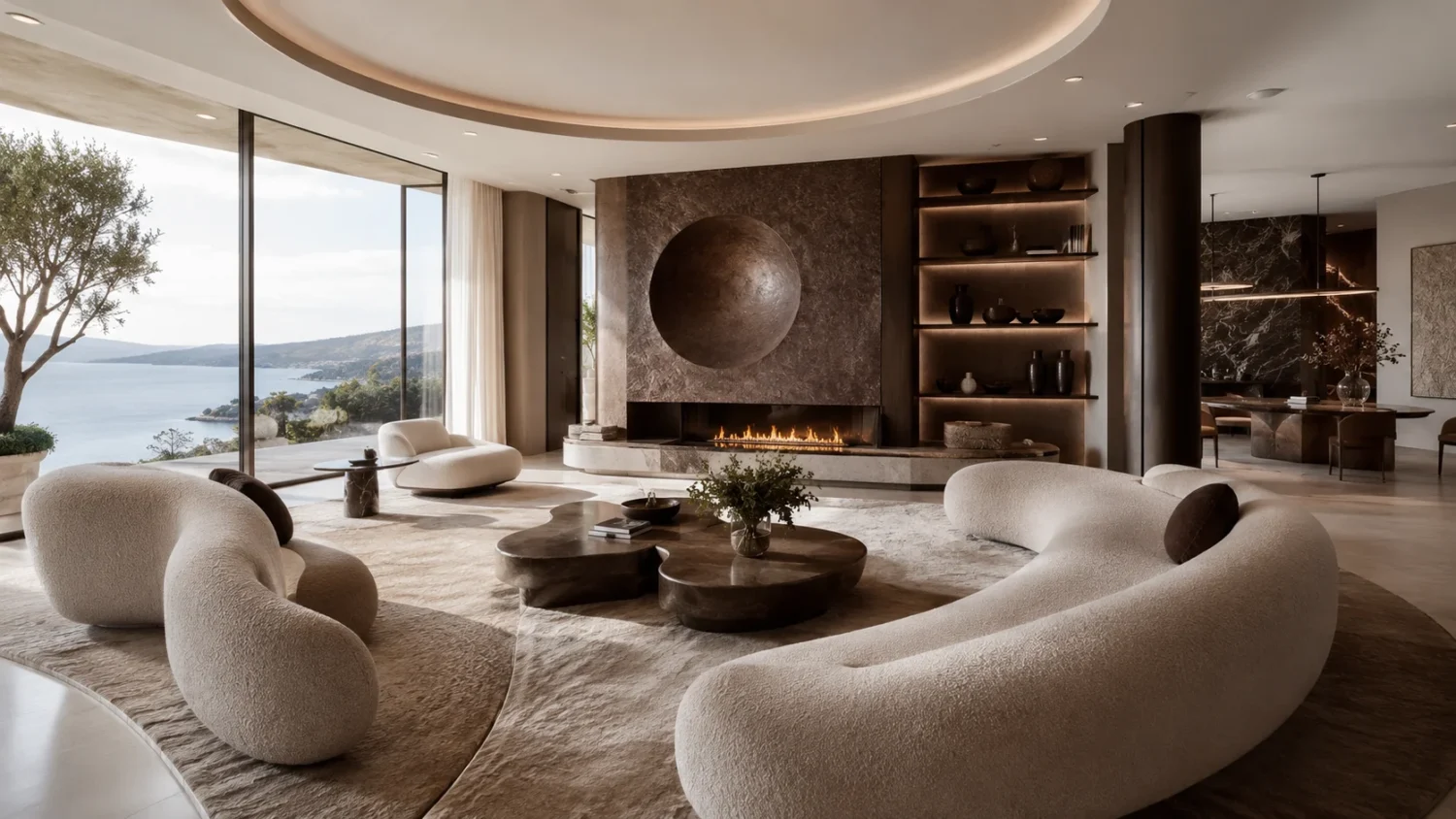

A luxury custom home is rarely remembered for its square metreage or the drama of its façade. What stays with people is far more tactile than that — the built-in banquette where the family gathers, the dining table scaled perfectly to the room, the sofa that seems to have been made for exactly where it sits, the wine wall glowing behind glass, the fireplace framed in stone chosen with real care. These are the details owners touch and use every day, and they do more to define how a home feels than any floor plan ever could. In the best custom homes, they were never an afterthought.
Furniture should be planned with the architecture
The common mistake, even in ambitious builds, is treating furniture as the final layer — something to sort out once the house is finished. In a custom home, that’s a missed opportunity. Furniture shapes circulation, sightlines, comfort, and storage; it decides how each room is actually lived in. The living room’s flow, the way a kitchen island anchors the space, the function built into a home office or a walk-in robe, the ease of an alfresco area or a home theatre — all of it is furniture and joinery working with the architecture, not sitting on top of it.
Which is why the thinking should start early, well before anything is built. Before a custom sofa, built-in cabinet, wine wall, outdoor lounge, or statement dining table is approved, homeowners and design teams can use sketches, material samples, shop drawings, mood boards, and 3d modelling services to understand proportion, finish, and placement within the overall home. Getting a piece right on paper, in the context of the actual room, is what keeps it feeling like part of the architecture rather than something moved in afterwards.
Bespoke pieces create a more personal home
The real argument for custom furniture is that it lets a home express how its owners actually live. A generously sized dining table says this is a household that gathers for long family meals. A deep outdoor lounge says the owners entertain, often, outside. A built-in reading nook, a tailored home office, bespoke wardrobes fitted to a specific wall, media-room seating built for the way this family watches films — each of these turns a general house into a particular one.
That’s the quiet luxury of bespoke: nothing is generic, and nothing is compromised to fit an off-the-shelf shape. When a piece is designed around a real routine rather than an average one, the home starts to feel less like a beautifully finished build and more like somewhere that was made for the people in it.
Material consistency matters
Individually lovely pieces don’t add up to a resolved interior unless they speak to one another. In a luxury home, the furniture has to belong to the same material conversation as everything around it — the flooring underfoot, the wall finishes, the cabinetry and benchtops, the lighting, the architectural detailing.
That coherence is what separates a considered interior from a collection of expensive things. A timber veneer that echoes the flooring. Stone on a table that answers the kitchen benchtop. Leather, linen, or bouclé chosen to sit with the palette rather than fight it, metal finishes that pick up the light fittings, glass and texture used with restraint. When these connections are deliberate, a home reads as one continuous idea. When they’re left to chance, even the finest pieces can feel like they wandered in from another project.
Visual planning helps avoid expensive mistakes
Decisions in a luxury custom home are costly and, once made, often difficult to undo. A bespoke piece fabricated at the wrong scale, or a finish that clashes once it’s in place, isn’t a quick fix — it’s a significant expense and a delay. This is exactly where visual planning earns its keep.
Seeing a piece properly before it’s built lets a homeowner and their design team weigh proportion, finish, placement, and scale while changes still cost nothing but a revision. For teams exploring how furniture-focused CGI can support product presentation, material studies, and interior concept development, CGIFurniture studio is one example of how digital visuals can help communicate furniture and product details before final decisions are made. Viewing a custom table in the context of the actual dining room, or a lounge against its real materials and light, turns an expensive leap of faith into an informed decision.
Built-in joinery can define the home
If bespoke furniture personalises a home, joinery is often what makes it feel resolved. A luxury home lives or dies on how organised it feels, and that sense of calm nearly always comes down to storage that’s been designed in rather than added on.
Consider how much of a home’s character sits in its joinery: the kitchen, the walk-in robes, a library wall, a bar, temperature-controlled wine storage, a mudroom that catches the chaos of family life, a laundry that works hard and looks considered, an entertainment unit that hides the technology. Well-designed joinery gives everything a place, which is what lets the architecture breathe. It’s the least showy part of a custom interior and frequently the most defining.
Outdoor furniture is part of the Australian luxury lifestyle
In an Australian custom home, the outdoor spaces aren’t secondary — they’re often where life actually happens. Alfresco dining, a poolside lounge, a covered terrace for year-round use, an outdoor kitchen, a fire pit set against a coastal or rural view: these are central to how these homes are lived in, and the furniture has to match that ambition.
The brief outdoors is demanding, though. A piece has to be beautiful, genuinely comfortable, and built to survive the climate it sits in — the coastal salt air, the harsh sun, the swings in temperature. Outdoor furniture in a luxury home should look every bit as considered as what’s inside, while quietly being engineered to hold its poise through seasons of real Australian weather. Get it right and the alfresco area becomes an extension of the home’s best rooms rather than a lesser afterthought beyond the glass.
Comfort is the quiet luxury detail
For all the talk of rare materials and dramatic design, luxury is often felt in far humbler things. The height of a seat. The clearance around a table that lets people move without a shuffle. Lighting soft enough to relax under. Storage that’s genuinely usable. Acoustic comfort in a big open space. Furniture that supports the ordinary routines of a day rather than fighting them.
These are the details nobody photographs, and they’re frequently what makes a home feel expensive to live in rather than just expensive to look at. A custom home feels resolved when the comfort has been considered as carefully as the aesthetics — when the piece isn’t only handsome, but a pleasure to actually use, morning after morning.
Final thoughts
Bespoke furniture and interior product detailing sit close to the heart of what makes a luxury custom home succeed. Planned early, alongside the architecture rather than after it, they let the structure, the interiors, and the way the owners genuinely live come together as a single, coherent experience. That’s the real mark of a resolved custom home — not the grandeur of any one element, but the sense that every detail, right down to the furniture, was considered as part of the whole.
You Might Also Like


