


I recently walked through a $3.2 million custom home in Melbourne with an architect who had specified Calacatta marble on nearly every surface. The finishes were stunning, but the main bathroom door had only 770 mm of clear width, so a standard wheelchair could not pass through it.
That is a high-end build with a basic access failure. Since NCC 2022’s Livable Housing Design, or LHD, provisions started rolling out across Australian states, the baseline for residential accessibility has shifted. Yet luxury projects still treat wheelchair access as a late adjustment instead of a core design decision.
Good accessible design does not weaken aesthetics. It improves them by making them feel smooth, generous, and deliberate.
The real test is simple: can a wheelchair move through the home, pass doors without clipping frames, and use the bathroom without help?
When those dimensions are solved early, the home works better on day one and keeps working for decades.
What Accessible Means in Australia
In Australia, strong residential accessibility starts with NCC 2022 LHD compliance and improves further when AS 1428.1 manoeuvring clearances are added.
Two documents shape the work. Start with NCC 2022 LHD provisions for legal compliance wherever they have been adopted, then use AS 1428.1 wheelchair clearances where independent daily use is the real goal.
LHD, found in NCC Volume Two Part H8 and the ABCB LHD Standard, covers step-free dwelling access, entrance and internal door widths, a compliant sanitary compartment, at least one hobless shower, and wall reinforcement for future grab rails. It applies to the nominated path, which is the required accessible route from the entrance to the key rooms on the entry level.
The dimension that causes the most confusion is 820 mm versus 850 mm. LHD mandates 820 mm clear openings at the entrance and internal doors on the nominated path, while AS 1428.1 requires 850 mm clear on a continuous accessible path of travel. Upgrading the doors used every day is one of the highest-value decisions you can make.
A quick adoption snapshot is still worth checking at development application stage. ACT adopted on 15 January 2024, VIC on 1 May 2024, SA on 1 October 2024, and TAS on 1 October 2024. Queensland implemented its requirements from 1 October 2023 through Queensland Development Code MP 4.5. NSW and WA are marked Not adopting on the ABCB table. Even where it is not mandatory, designing to LHD still supports resale, aging in place, and guest access.
Plan the Layout for Flow
If the layout does not support smooth wheelchair movement, no amount of finish quality will fix the problem later.
Circulation Widths and Turning
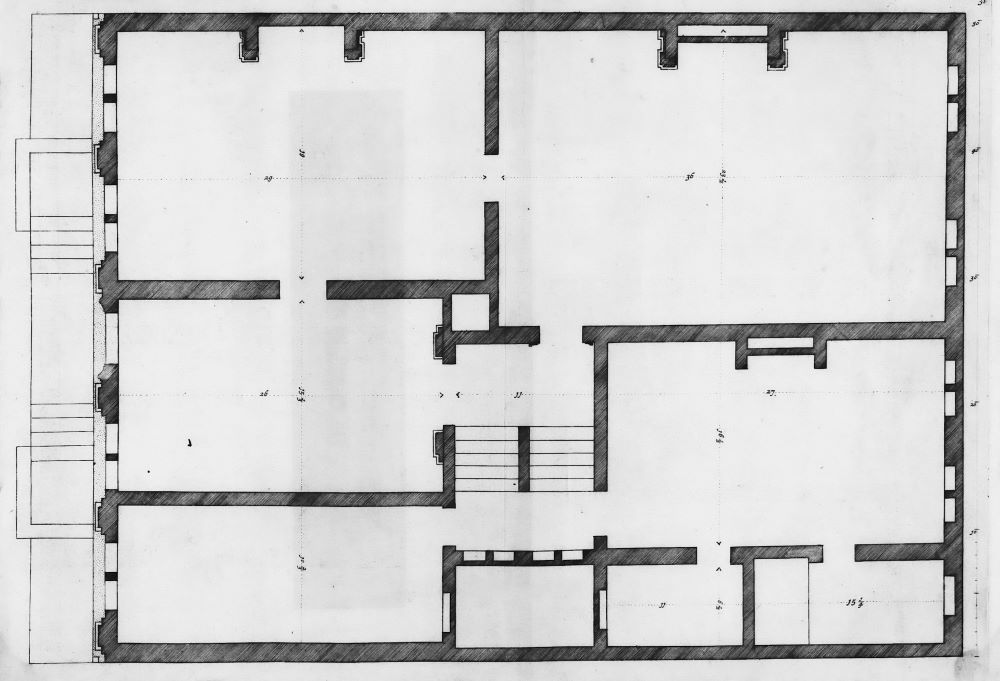
Corridors on the nominated path require 1000 mm minimum clear width under LHD. At key junctions, allow 1500 x 1500 mm for a comfortable 90-degree turn. Where a full 180-degree turn is likely, target 2070 x 1540 mm clear.
Long corridors need more than a code minimum. An 1800 x 2000 mm passing bay helps when two wheelchairs meet, or when a wheelchair user crosses paths with a pram, trolley, or carer.
Room Adjacency and Vertical Circulation
Keep a direct, level path from the entry to the living area, kitchen, at least one bedroom, and the compliant sanitary compartment. Avoid pinch points at door approaches, and use pocket or cavity sliders where a hinged door would eat into clear floor space. In multi-level homes, make the ground floor fully usable, then reserve space for a future lift shaft or stair-lift without weakening the main path today.
Access Path Fundamentals
The step-free access path must be at least 1000 mm wide, with a crossfall no steeper than 1:40. Ramps on that path are limited to gradients between 1:14 and 1:20 with 1200 mm landings. A short step-ramp is allowed at up to 1:10 for a 190 mm rise. At the entrance door, provide a 1200 x 1200 mm external landing with the same maximum crossfall of 1:40.
Mobility Equipment Strategy and Storage
Good planning also makes space for the chair when it is not in use. A practical storage bay near the garage or main entry should include easy-clean flooring, good lighting, and GPOs placed around 1000 mm above floor level for charging power assist units or related equipment.
A second chair can solve problems that architecture alone cannot. Travel days, weekend visitors, and multi-storey homes all create situations where a lighter backup chair is useful, especially when the main daily chair is heavier or customised.
If you are comparing compact backups, think about who will lift the chair, how often it must be folded, and where it will live between trips. Check folded width, lifting weight, and how easily the chair fits into a car boot or mudroom cupboard, then, if you want a curated starting point, discover quality foldable wheelchairs and compare them with other light travel models. A spare chair that stores quickly can prevent the last-minute access compromises that undo an otherwise thoughtful home.
Size Doors, Entries, and Thresholds
Doors are where accessible homes succeed or fail, so the detail must be clear and repeatable across the whole nominated path.
For the entrance door, specify an 820 mm clear opening minimum with a 1200 x 1200 mm external landing and crossfall no steeper than 1:40. Thresholds should be level, have a bevelled lip of 5 mm or less, or be ramped within the frame at no steeper than 1:8. In higher-end homes, automatic openers linked to the security system can remove a daily barrier without changing the visual language of the facade.
Internal doors on the nominated path also require 820 mm clear openings, with thresholds detailed to the same standard. In practice, an 870 mm leaf is a reliable way to achieve 820 mm clear once door stops and hardware are accounted for. Lever sets or D-handles are easier to grip than round knobs, and a visible colour contrast at the door edge helps low-vision users find the opening.
Where should you upgrade to 850 mm clear under AS 1428.1? Focus on the rooms used several times each day, including the kitchen, primary bedroom, laundry, and the bathroom used most. The cost increase is small, but the difference in comfort and independence is immediate.
Build Bathrooms That Work
The bathroom is the room where compliance, safety, and comfort need to work together with no weak point in the plan.
Toilet Zone
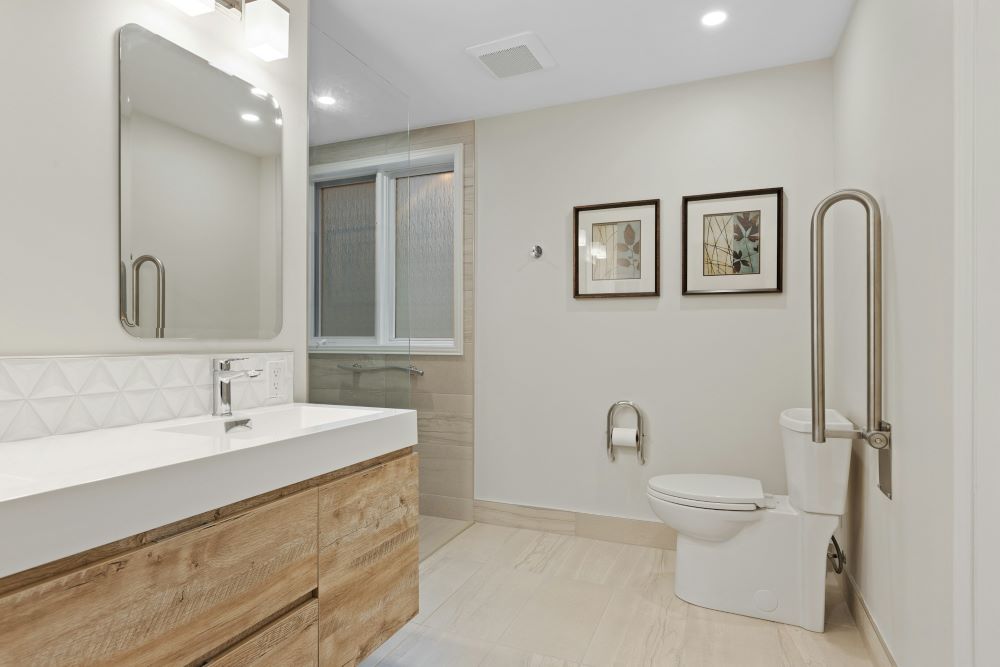
The compliant sanitary compartment requires a 900 x 1200 mm clear zone immediately in front of the pan. If the WC is enclosed, maintain 900 mm clear width wall to wall and keep at least 450 mm from the pan centreline to any obstruction. Hang doors to swing outward, or use a cavity slider, so the clear zone stays usable.
Shower
At least one shower must be hobless and step-free. A 5 mm waterstop lip is allowed, but the floor should still read as continuous and easy to traverse. Government guidance illustrates adaptable shower modules around 1160 x 1100 mm, though larger dimensions are easier to use. All wet areas must comply with AS 3740 or the ABCB Housing Provisions for waterproofing.
Reinforcement and Finishes
Line stud walls around the pan and shower with 12 mm plywood or 25 mm timber noggings so future grab rails can be installed without opening the wall later. Concrete and masonry walls do not require extra sheeting. If you use cavity sliders nearby, coordinate the framing early so reinforcement stays continuous.
Luxury and accessibility can sit in the same detail. Stone or porcelain with P4 or P5 slip resistance in wet zones, flush linear drains, frameless glass, and warm-contrast tapware all improve safety without making the room feel clinical. Leave enough clear floor space at the vanity for a front or angled approach, and keep mirrors, basins, and storage easy to reach from a seated position.
Support Everyday Independence
The most effective upgrades outside the bathroom are the ones that reduce awkward reaching, turning, and lifting every single day.
In the kitchen, provide knee clearance at a section of bench, especially at the sink and, where possible, the cooktop. Side-opening or under-bench ovens, drawers instead of deep cupboards, and pull-down upper shelving all reduce strain. These are practical changes, not special extras.
Living areas also need room to move. Government guidance recommends a 2250 mm turning diameter in living rooms for comfortable wheelchair manoeuvring, which matters once sofas, coffee tables, and rugs are in place. Two-way switching at logical room entries also helps seated users avoid unnecessary backtracking.
For bedrooms, make sure at least one entry-level room has an accessible path with 820 mm doors and 1000 mm corridors. Plan bedside GPOs for chargers or medical devices, and if the house has more than one level, leave structure and ceiling space that could support a future hoist or lift strategy.
Place Lighting, Controls, and Smart Features
Controls only help if a seated user can reach them without twisting into a corner or stretching over furniture.
YourHome recommends GPOs at least 600 mm above floor level and switches between 900-1100 mm above floor, with both kept at least 300 mm from internal corners. That small positioning change has a big effect on daily ease, especially near beds, benches, and doorways.
Automatic night lighting in corridors and bathrooms can reduce falls risk, and smart features can quietly remove friction. Touchless taps, voice-controlled lighting scenes, powered doors, app-based blinds, and video doorbells all support independence without making the home look specialised.
Make Accessibility a Design Standard
The best accessible homes feel calm and generous because the critical dimensions were solved before the finishes were chosen.
Use LHD details as the baseline across every door, corridor, and threshold on the nominated path, then apply AS 1428.1 clearances where a full-time wheelchair user will benefit most. That approach gives you compliance first and better daily usability where it matters most.
Bring the architect, builder, and occupational therapist into the conversation at concept stage, not after framing. Document the nominated path, compliant entrance, and sanitary compartment early, and confirm local LHD adoption before the project is lodged.
The homes that get this right do not look accessible first. They look well planned, easy to move through, and ready for real life.
Common Questions
These are the dimensions and decisions clients ask about most during early planning.
What door sizes should I specify?
For LHD compliance, show 820 mm clear openings on the nominated path, which is commonly achieved with about an 870 mm leaf. For daily-use rooms such as bedrooms, kitchens, and primary bathrooms, upgrade to 850 mm clear where you want stronger wheelchair usability.
What corridor width works?
LHD requires 1000 mm minimum clear width on the nominated path. On longer runs, add an 1800 x 2000 mm passing bay where two chairs, or a chair and a pram, may need to pass each other.
How much space do I need in front of the toilet?
Allow a 900 x 1200 mm clear zone immediately in front of the pan in the compliant sanitary compartment on the entry or ground level. That space should stay clear of door swings and fixed joinery.
Do I need a hob at the shower?
No. LHD requires at least one hobless, step-free shower, although a 5 mm waterstop lip is permitted. The wet-area build-up still needs to meet AS 3740 or the ABCB Housing Provisions for waterproofing.
What turning space should I plan for?
For a 90-degree turn, aim for 1500 x 1500 mm. For a 180-degree turn, allow 2070 x 1540 mm in line with AS 1428.1. These are useful targets in kitchens, bathrooms, and room junctions.
Where should switches and power points go?
Place GPOs at least 600 mm above floor level and switches between 900-1100 mm above floor level, with both kept at least 300 mm from internal corners. Those locations are easier to reach from both seated and standing positions.



