
For a long time the sofa bed was the piece of furniture nobody chose. It was inherited, or bought in a hurry for a spare room, and then resented by every guest who spent a night on a mattress the thickness of a folded towel with a steel bar under the small of their back.
That reputation was earned. But it is also a decade out of date, and a look through a current sofa bed range from a retailer such as OMF shows how far the category has moved.
Walk through the living and guest spaces of a well-planned home today and there is a good chance at least one sofa is not quite what it appears to be. The study has a sofa that becomes a double bed when the in-laws visit. The media room lounge turns a second living area into a bedroom for the school holidays, and the compact two-seater in the granny flat gives one room two different jobs.
What has changed is that the sofa bed has stopped being a compromise on both counts. The good ones are now sofas you would choose for the living room anyway, with a bed that people can sleep on for a week without complaint. Below is a rundown of what has changed, where a sofa bed earns its place, and how to choose one you would be happy to sleep on yourself.
Why Are Sofa Beds Back?
The first reason is how we plan rooms now. Even in a large custom home, the dedicated guest bedroom that sits empty forty-eight weeks of the year is a harder sell than it used to be. Home offices, gyms, media rooms and second living areas have all claimed square metres that once went to a spare bedroom. The rooms that survive have to do more than one thing.
The second is that the furniture has caught up. Pocket spring seats, laminated veneer lumber frames and properly engineered mechanisms have replaced the thin foam and folding cot frames of older designs. A modern sofa bed can be a sofa you choose on its own merits, with the bed as a bonus rather than the reason you tolerated it.
What Is The Difference Between A Fold-Out And A Pull-Out Sofa Bed?
The mechanism decides how the bed feels to sleep on, so it is worth settling before you look at fabric swatches.
A fold-out sofa bed stores a mattress folded beneath the seat cushions. You remove the cushions, pull a handle and the mattress unfolds forward. This is the traditional style, and the newer versions are far better than their ancestors because the mattress is thicker and the frame is designed to sit flat rather than sag into a hammock.
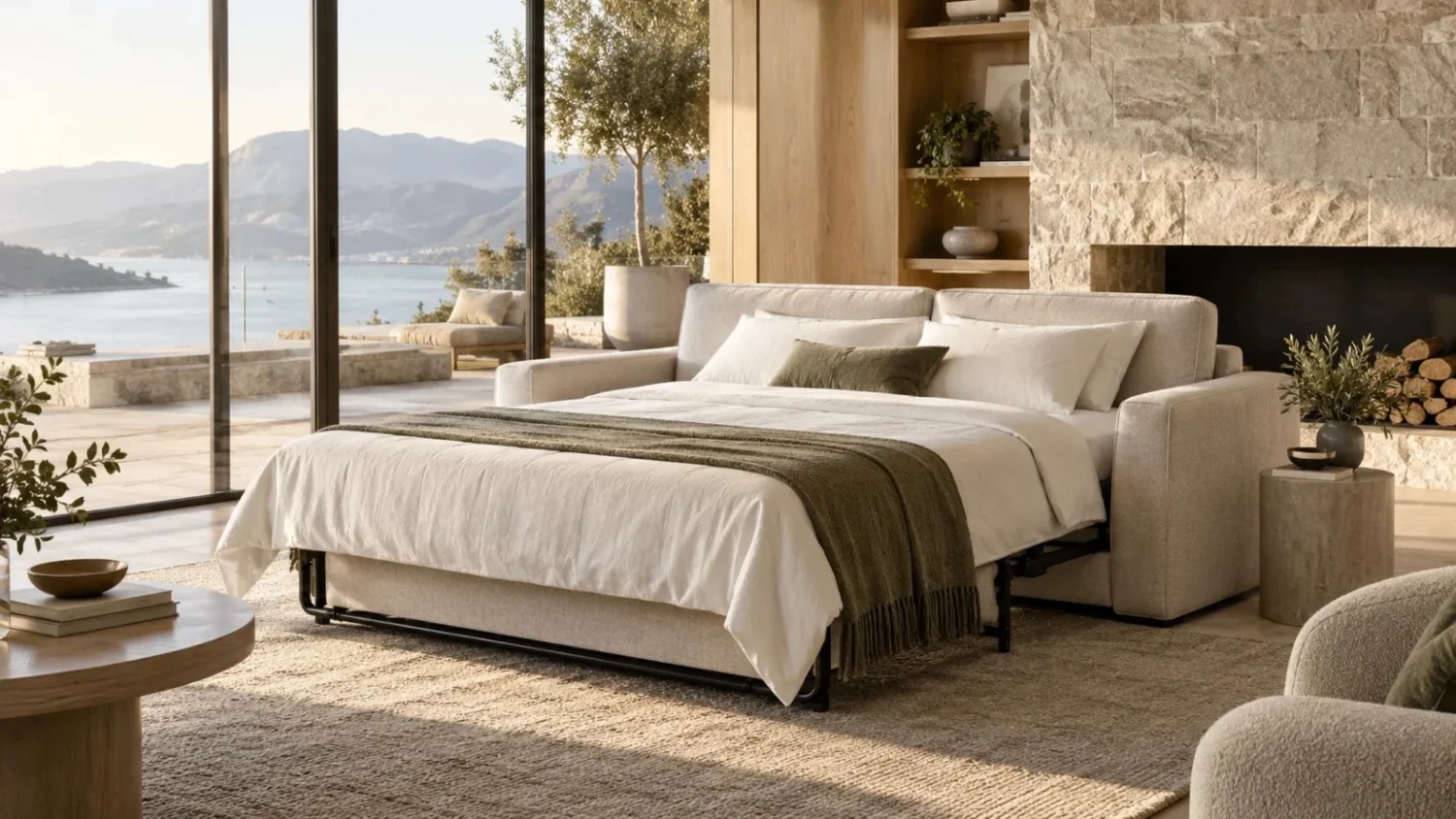
A pull-out or pull-up sofa bed works differently. The seat slides or lifts forward and the back drops down to meet it, so the surface you sleep on is the same sprung seat you sit on during the day. There is no separate thin mattress and no bar frame underneath, which is why these are usually the most comfortable to sleep on and the quickest to convert.
A click-clack design simply drops the backrest flat to form a bed. These are the cheapest and lightest option and the easiest to move, but the sleeping surface is generally firmer and narrower. They suit a teenager’s room or a studio far better than a formal guest space.
If overnight comfort is the priority, look at pull-out and pull-up designs first.
Where Does A Sofa Bed Work Best?
A sofa bed is at its best in a room that already has a daytime purpose.
The home office is the obvious one. A two or three-seater against one wall gives you somewhere to sit and read during the week, and turns the study into a proper guest room when someone stays, without anyone having to move the desk or the filing cabinet.
Second living rooms and media rooms are another natural fit, particularly in larger family homes where adult children come back for Christmas with partners in tow. A generous three-seater or a chaise sofa bed here can sleep two comfortably without anyone giving up their bedroom.
Granny flats, studios and small apartments are where sofa beds have always made sense, and the compact two-seater designs available now look far better than the old fold-outs. In a room that has to be a lounge by day and a bedroom by night, a sofa bed that looks like a sofa is the difference between a space that feels finished and one that feels like a bedsit.
When A Sofa Bed Is The Wrong Choice
If someone is going to sleep on it most nights, buy a bed. Sofa beds are built for regular guest use, not for replacing a mattress, and even a good one will not be as comfortable long term as a proper mattress on a proper base.
Space is the other issue. A fold-out needs roughly two to two and a half metres of clear floor in front of it once it is open, plus somewhere to walk around it. In a narrow study with a desk opposite, that may simply not be there. Measure the room with the bed extended, not just the sofa closed.
Then think about who is sleeping on it. A click-clack is fine for a nephew on a Friday night. It is not what you want to offer your parents for a fortnight.
What Should You Look For In A Sofa Bed?
Start with the frame. Laminated veneer lumber, usually abbreviated to LVL, and steel are what you want to see in the specifications. Both hold their shape under the repeated stress of opening and closing, which is where cheap sofa beds fail first. Particleboard and stapled softwood are a warning sign.
Then look at what is under the seat. Pocket springs or a sprung coil seat will hold up to years of sitting and sleeping far better than foam alone, and they make a real difference to how the bed feels at three in the morning.
Check the converted dimensions, not just the sofa dimensions. A three-seater sofa bed that opens to a double is common. One that opens to something closer to a queen is less common and worth paying for if adults will be sharing it.
Ask about the mechanism warranty separately from the fabric warranty. A five-year frame warranty tells you the manufacturer expects the mechanism to last.
Finally, sit on it and then lie on it. If you can try one in a showroom, do. If you would not be happy sleeping on it yourself, your guests will not be either.
What Fabric Works Best For A Sofa Bed?
Because a sofa bed gets handled more than a normal sofa, with cushions lifted off and put back and a mechanism pulled in and out, the fabric needs to cope with that.
Tightly woven polyester blends and treated easy-clean fabrics are the practical choice, particularly in a room that is used by children or as a media room where food and drink are inevitable. Loose back cushions are useful too, because they can be removed, turned and plumped, and they make the bed easier to set up.
Sofa beds are often bought for secondary rooms, and it is tempting to default to safe grey. A green, navy or warm beige that connects to the rest of the house will make the room feel considered rather than furnished from the leftovers.
How To Style A Room Around A Sofa Bed
The room needs to read as a living space first.
Keep the floor in front of the sofa clear, which usually means a lighter coffee table that can be moved with one hand, or a pair of small side tables instead of one large one. A storage ottoman is a good idea here. It gives guests somewhere to put a bag and gives you somewhere to keep the spare linen.
Use a rug that is large enough to sit under the sofa and extend past the fully opened bed. A rug that stops short of the mattress makes the whole arrangement look temporary.
Treat the bedding as part of the room, too. A quilt, a couple of good pillows and a throw stored nearby mean the bed can be made up properly in five minutes, and the room never has that fold-out-in-the-middle-of-the-floor look that made sofa beds unloved in the first place.
Sofa Beds To Consider
OMF built its name on mattresses, which is a useful pedigree for a sofa bed, and its sofa bed range covers most of the ground discussed above, from compact two-seaters for a studio through to full three-seater pull-up designs for a second living room. A few worth looking at:
OMF Montana 3 Seat Pull Up Sofa Bed
The Montana is the option for a room where the sofa has to look like a permanent piece of furniture. It is a modular design with a storage chaise, built on an LVL frame with S-springs and pocket springs in the seat, and a reinforced metal structure behind the pull-up mechanism. Fixed seat cushions keep it tidy, loose back cushions keep it comfortable, and the Miles easy-clean fabric is designed for households with children. It has a five-year frame warranty and comes in Slate and Light Grey.
OMF Seattle Sofa Bed
The Seattle is a fold-out three-seater with a steel sprung pocket coil seat on an LVL plywood frame. Closed, it is 183cm wide and 86cm deep. Opened, it extends to 182cm deep, which is the measurement to check against your floor plan. The loose back design and easy-care fabric make it a sensible choice for a study or granny flat, and it ships knock-down so it will get through a narrow door.
OMF Two-Seater Sofa Beds
For apartments, studios and smaller guest rooms, OMF’s two-seater designs including the Calder, Cove, Auren and Aveline give you a proper sofa in a footprint that leaves room for the rest of the furniture. Several come in green, brown and beige as well as grey, which makes it easier to tie the room into the rest of the house. The full range, with current pricing, is on the OMF sofa bed collection page.
OMF sofa beds can be tried in store at more than 50 locations across NSW, VIC, QLD and the ACT, or ordered online for home delivery.
Is A Sofa Bed Worth It?
If the alternative is a spare bedroom that stays shut most of the year, yes.
A good sofa bed lets a study stay a study, a media room stay a media room, and a granny flat feel like an apartment rather than a bedroom with a kettle in it. It is the piece that lets a house with four bedrooms behave like one with five, without adding a wall.
The only way it goes wrong is buying it as an afterthought. Choose the mechanism for the guests you have, measure the room with the bed open, and lie on it in the showroom before you commit.
You Might Also Like