
For anyone drawing up a custom home this year, the exterior palette has quietly shifted. Where rendered masonry or fibre-cement once filled the elevation, more architects are now reaching for charred timber – and the briefs landing on my desk have changed with it. The question is no longer “what is yakisugi?” but “how do I specify it so it performs?”
It’s a fair question, because the gap between a charred facade that ages gracefully and one that disappoints comes down almost entirely to specification. Here is what I tell the builders and designers I work with.
Start with the species. Yakisugi – the Japanese discipline of charring timber to protect it – was developed around sugi, or Japanese cedar, for good reason. Sugi is light, dimensionally stable, and accepts the char evenly, so the protective carbon layer forms consistently across the board. Substituting an Australian hardwood to chase the same look is where many projects come unstuck: you may get the colour, but not the behaviour. If a supplier can’t tell you the species, treat that as a red flag.
Then the finish. “Charred” is not one product. A deep, brushed-black board, a lightly textured grey and a warm custom tone are produced by different degrees of charring and brushing, and they weather differently once installed. Decide the finish early, because it sets the entire material conversation around it – the window frames, the roof and the landscaping all answer to it.
On performance, the appeal for custom builds is straightforward. The carbon layer is naturally resistant to rot and insects and far more UV-stable than a coated board, which means a facade that holds its character for years without an annual re-coat. For clients who are tired of maintenance schedules – and most people building a forever home are – that durability is often the deciding line in the proposal.
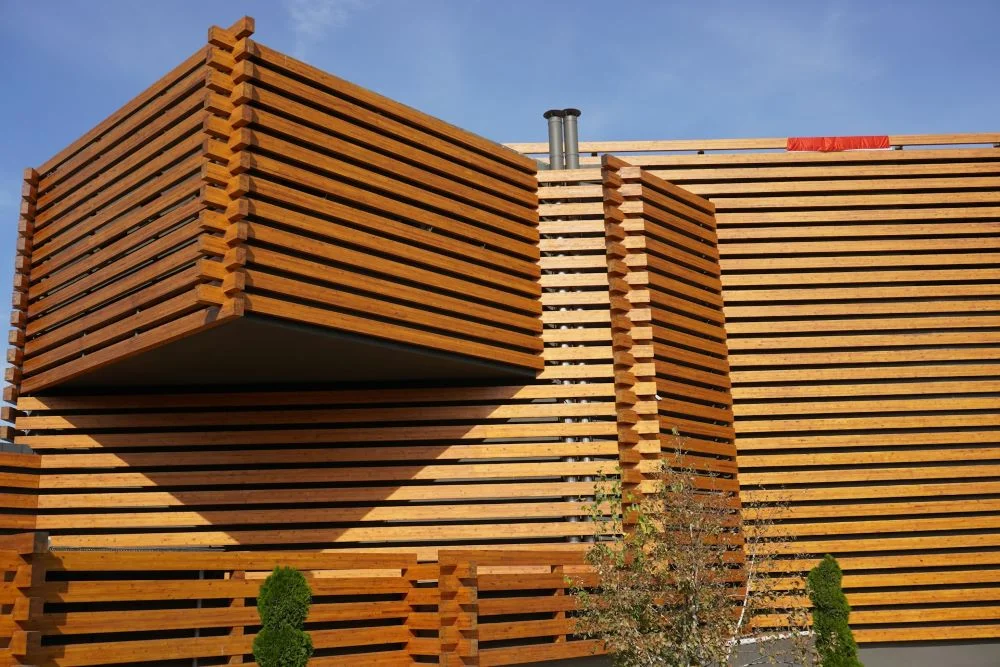
Detailing is where good intentions are won or lost. Like any quality timber facade, charred cladding wants a ventilated cavity behind it; design the batten zone and flashings before you commit to a board layout. The profiles are flexible – shiplap, board-and-batten or an expressed shadow-gap, run vertically or horizontally – and the same boards translate beautifully to soffits and feature walls. Because the finish is pre-applied, the trade emphasis on site is simply protecting the carbon layer during fixing rather than coating after.
A note for specifiers thinking about compliance: charred cladding is a timber product and should be assessed like one against the site’s bushfire and building requirements. Worth raising with the certifier early rather than late.
The palette is broader than people expect. We supply our charred sugi in a small range of signature finishes – a deep char, a softer brushed option and warm custom colours – so a project can be matched rather than forced into a single black. You can see the range at Studio Tsukuru; for a custom build I’d always send physical samples to view on site first, because charred timber changes character with the light it sits in.
Finally, the part that increasingly closes the deal: the sustainability case. Charring is a chemical-free way to make timber last – no solvents, no constant recoating – and when the cedar is responsibly sourced, it’s a facade a client can stand behind on more than looks.
Specify it well – right species, right finish, proper cavity, samples on site – and yakisugi rewards the effort. On a custom home it reads as intentional on day one, and only looks more so as the years pass.
You Might Also Like