
Most homeowners spend months agonizing over tile grout, tapware finishes, and furniture placement – then hang a generic canvas print on the wall as an afterthought. It’s the single most common interior design mistake in Australian homes, and it’s so easy to fix.
The walls are the largest uninterrupted surface in any room. What you put on them doesn’t just fill space – it tells visitors something about who you are, sets the emotional temperature of the room, and ties together every other decision you’ve made. Art is the difference between a house that looks styled and one that feels lived in by a real person with real taste.
This article covers two practical paths to getting art right in your home: creating your own pieces and choosing original paintings by living artists. Both can work in any room, at any budget, and neither requires you to spend a weekend in a gallery pretending to understand oil texture.
The case for making your own wall art
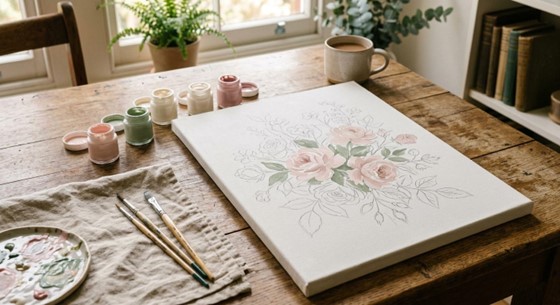
Paint-by-numbers kits for adults produce genuinely personalized artwork – no prior experience needed.
Paint-by-numbers has had a real image problem. For decades, it was filed under “children’s rainy-day activities” and forgotten. That’s changed. A 2025 trend report from Italian Bark, citing Pinterest data, found that searches for hand-painted wall treatments rose 60% in 2025 – driven almost entirely by adult homeowners, not kids.
The appeal is straightforward. A kit painting is original in the way a framed print can never be. You mixed the colors. You made the decisions about pressure and blending. The finished piece carries a kind of personality that you simply can’t buy off a shelf at a homewares chain.
For anyone wanting to try it, visit Number Artist for a curated range of paint-by-numbers kits designed for adults, including botanical and floral subjects that suit Australian interiors particularly well. The quality gap between a proper adult kit and the cheap sets you’d remember from childhood is significant – think pre-mixed color palettes, detailed line work, and canvas sizes large enough to make a real statement on a wall.
Why art belongs in every room
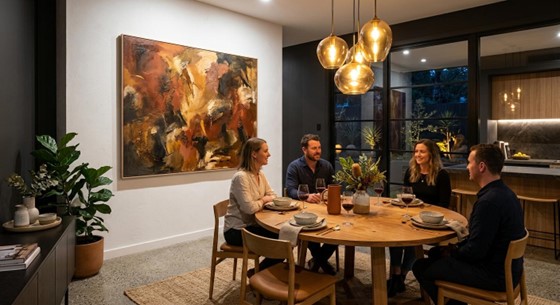
Oversized art in a dining room creates a focal point that pulls the entire space together.
The numbers are worth knowing. According to Fortune Business Insights (2025), the global wall art market was valued at USD $66.89 billion in 2025 and is projected to reach USD $118.79 billion by 2032. Homeowners aren’t just decorating – they’re allocating real budget to art in a way that would have seemed unusual ten years ago.
There’s a wellbeing case too. A 2025 systematic review in the Journal of Positive Psychology (Taylor & Francis) found that viewing art in home settings is linked to measurable improvements in mood and stress reduction. Not just gallery visits – specifically art in the home.
Designers are paying attention. The 1stDibs Designer Trends Survey 2025 found that 46% of interior designers planned to display more paintings in client homes that year than in any previous year. Sculpture followed at 41%. That preference shows up in the types of work getting commissioned: large-scale works by Australian artists are increasingly appearing as centerpieces in custom-built homes, not decorative flourishes added at the end.
If you’ve been treating art as the last thing to sort out, it’s worth reversing that. Start with one strong piece, build the color palette from it, and let the furniture decisions follow.
Matching art to your rooms – style, scale, and mood
Scale is the most common thing homeowners get wrong. A small painting on a large wall doesn’t read as understated – it reads as unfinished. The 2025-2026 trend toward oversized art isn’t just an aesthetic choice; it reflects what actually works in rooms with high ceilings and open-plan living areas, which are common in most new Australian custom builds.
For contemporary interiors, abstract and painterly works tend to land well. The 1stDibs survey found 48% of designers prefer abstract for modern spaces. But figurative and landscape art is gaining ground too, particularly in homes with more traditional or coastal styling.
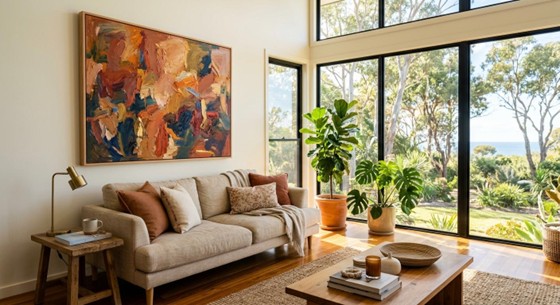
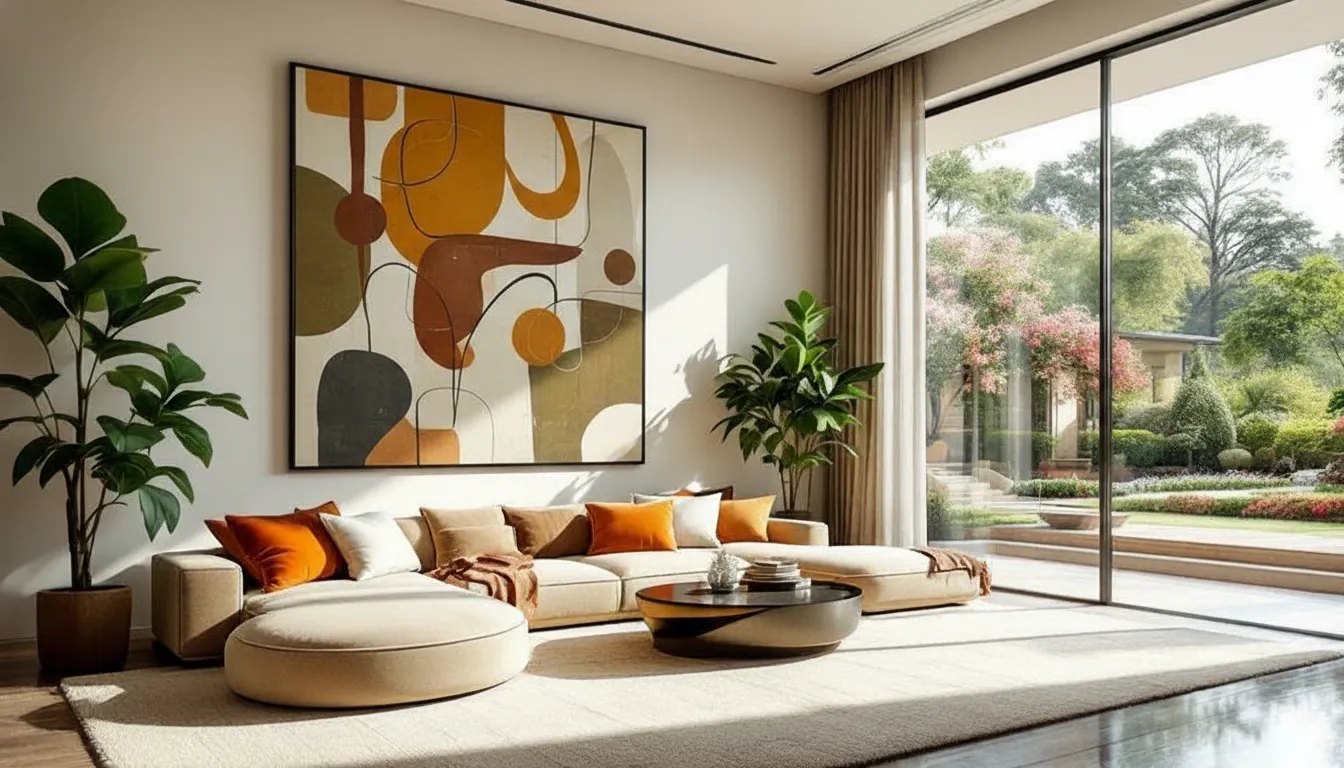
A statement painting anchors this light-filled living room and sets the color palette for the entire space.
Color is where people overthink it. Pick art you respond to, then work backward. Dulux named “Rhythm of Blues” – a family of three tones from soft slate to deeper ocean – as its 2026 Color of the Year. A painting that references the same family of tones as your walls and soft furnishings will read as intentional. Art that clashes with every other surface in the room doesn’t read as bold; it reads as unplanned.
A 2025 scoping review published in Nature’s Humanities and Social Sciences Communications, which analyzed 64 empirical studies, confirmed that biophilic design elements in the home – including nature-inspired art – significantly reduced stress and anxiety as measured by heart rate and blood pressure. Worth factoring in when you’re deciding what actually goes on the wall.
For practical guidance on layering texture and color in your interior, the approach Anna Chandler takes – building rooms around objet d’art and strong pattern choices – shows how art-led interiors actually come together.
Original flower paintings as a signature design move
There’s a reason floral art has never really gone out of style in Australian homes. It brings color, softness, and a sense of the natural world into a space without the maintenance requirements of actual plants. Where outdoor gardens are a major feature of a property, interiors that reference botanicals feel like a natural continuation rather than a separate design statement.
What separates an original flower painting from a botanical print is texture and singularity. The brushwork on a hand-painted canvas catches the light differently. Original pieces by living artists carry the knowledge that no one else owns the same work, which matters more than it sounds in a world where most homewares are mass-produced.
For anyone building a statement wall or looking to add a genuine focal point to a bedroom or sitting room, browsing for a perfect flower painting for sale is worth the time. Original paintings by working artists bring a different energy to a room than reproductions ever can, and the price gap between an original and a high-quality framed print is often smaller than people expect.
The work in Felicia Aroney’s Magic Garden series is a good reference point: textured, large-scale botanical paintings that sit comfortably in a luxury interior without reading as purely decorative. That’s the standard worth aiming for.
Building a home that reflects who you are
The best-decorated homes aren’t the ones with the most expensive furniture. They’re the ones where it’s obvious that someone made real choices – not just safe ones.
Art is where that specificity lives. It’s harder to fake personality through a sofa selection than through what you choose to hang on your walls. Generic prints read as generic regardless of how expensive the frame is.
The two paths here – making your own art through a quality paint-by-numbers kit, and investing in original paintings by living artists – both lead to the same outcome: walls that tell a story. The first option is more personal and often more affordable. Original works by emerging Australian artists can also appreciate in value over time, particularly as those artists build a profile.
Don’t treat art as a finishing touch you’ll get to eventually. It should be one of the first decisions you make. Start with one strong piece. Everything else gets easier once you know what you’re designing around.