
External roller shutters are the most underspecified element in most new Australian homes. Buyers spend months agonising over kitchen splashbacks and bathroom tiles, then dedicate a single late-stage conversation to the boxes that will end up controlling heat gain, security, acoustic performance, and the long-term running cost of the property. The pieces of hardware that sit hidden in the eaves of a well-designed home do more work than almost any other component of the build, and they tend to be specified last when they should be specified first.
The case for external rollers as a default inclusion rather than an upgrade has strengthened over the past five years. Energy costs have risen. The frequency of severe weather events recorded by the Bureau of Meteorology has increased the appetite for resilient building hardware. And the gap between external and internal shading, in terms of measurable thermal performance, has become impossible to ignore on the energy assessment side of a new build.
Why External, and Why Roller
The thermal physics of window shading sits at the heart of the case for external rollers. Sunlight hits the outside face of the glass. If the absorbing surface is on the inside of the home, the heat has already entered the building envelope before any blind or curtain can intercept it. The only mechanism that stops solar gain at the boundary, before it becomes a cooling load on the air conditioning system, is external shading.
Roller shutters do this with an efficiency that fixed eaves, awnings, and pergolas cannot match. They cover the full opening on demand, retract completely when not needed, and add a thermally insulated layer when fully closed at night. A correctly specified external roller can reduce summer heat gain through a west-facing window by a significant margin and reduce winter heat loss through the same window by a similar margin. The Australian Government’s Your Home guide documents the contribution of external shading to whole-of-home thermal performance.
The Six Functions a Single Product Performs
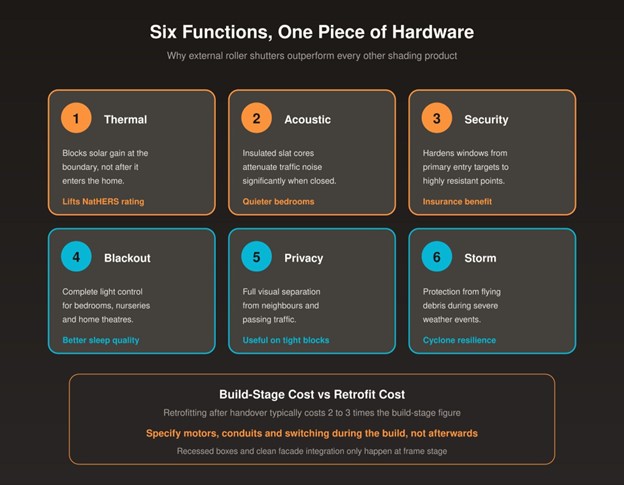
Few building products do as much as an external roller shutter. The slat construction provides thermal performance, acoustic dampening, light blackout, privacy, intrusion resistance, and storm protection in a single piece of hardware. When the design conversation accounts for all six functions rather than just one, the value calculation looks very different to a comparison made on aesthetics alone.
The Energy Performance Case
Where seven-star NatHERS performance was once a premium feature, it is now the floor for new builds in much of the country. Stepping from seven to eight stars usually requires intervention on glazing performance and shading, and external rollers are one of the most cost-effective levers available. The Nationwide House Energy Rating Scheme credits the contribution of operable external shading in its modelling, and many builders are now using external rollers strategically to lift overall ratings without the expense of upgrading every window assembly.
The summer reduction in cooling load matters most in homes with significant west-facing or north-facing glazing. The winter reduction in heat loss matters most in cool temperate climates. Properties in both situations benefit from the same hardware, used differently across the seasons.
Security Without the Visual Compromise
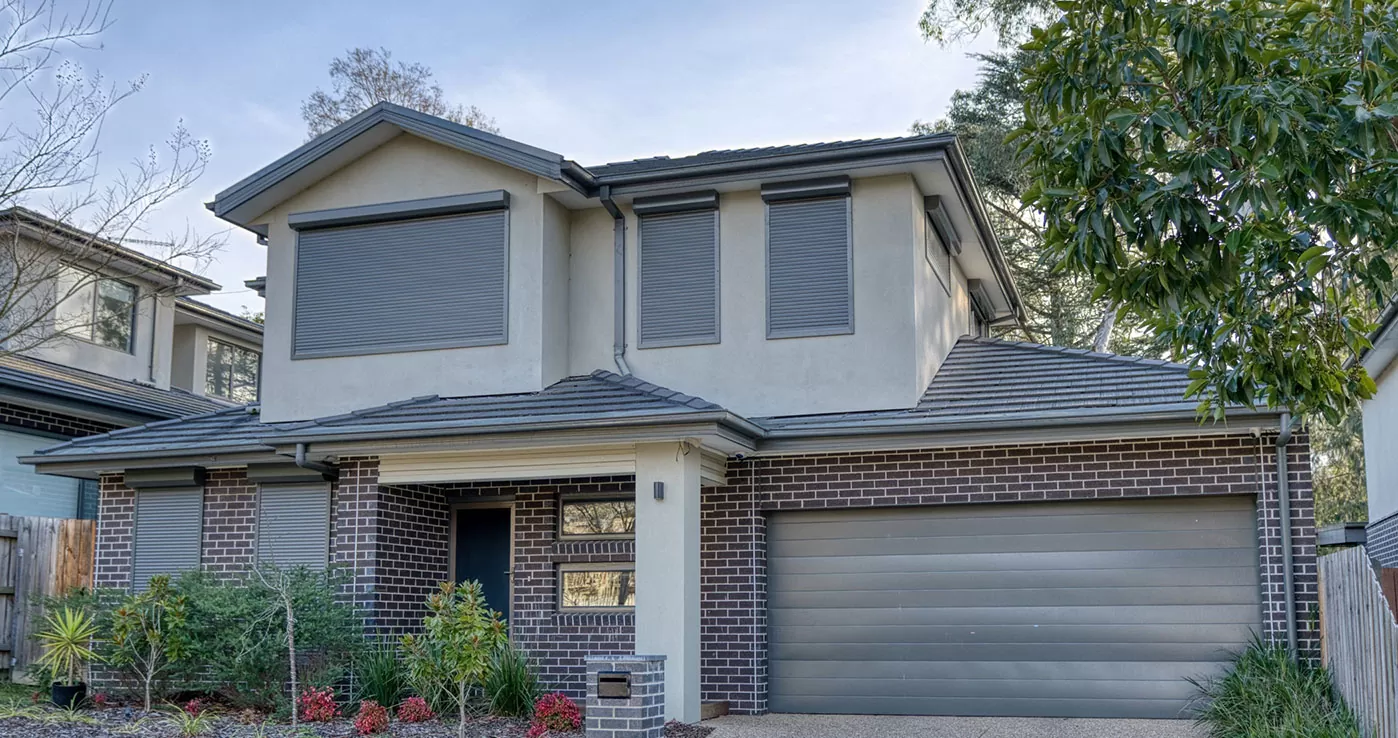
Modern window shutters for the home have moved well beyond the heavy, industrial appearance of earlier generations. Slat profiles have been refined for residential aesthetics. Box housings can be fully recessed into the cavity or eave so they disappear when retracted. Colour matching to facade trim is now standard, and the shutters integrate visually into contemporary architecture rather than fighting it.
The security benefit, however, is tangible. A locked external roller turns a window from a primary intrusion target into one of the hardest entry points on the property. Insurance underwriters recognise this, and several Australian insurers offer premium adjustments where verified external rollers are fitted to vulnerable openings. The Australian Institute of Criminology has consistently identified visible perimeter and opening hardening as effective burglary deterrents.
Acoustic Performance Is the Quiet Bonus
For homes near busy roads, flight paths, or commercial precincts, the acoustic dampening of closed external rollers can transform the night-time experience of the property. Insulated slat cores attenuate traffic noise by a meaningful margin, and the bedrooms behind them sleep noticeably quieter than otherwise identical rooms without external shading. This is particularly useful in greenfield estates where homes back onto arterial road reserves.
Specifying External Rollers During the Build
Three integration wins disappear once the home is finished. The first is electrical. Hardwired motors with concealed wiring need conduit runs that match the rest of the home’s electrical plan, and switching locations need to be designed alongside the lighting plan. The second is structural. Box housings can be fully recessed into the cavity or eave when planned in advance, producing a clean architectural facade. The third is smart home integration. Shutters wired into the home’s controller at the build stage feel like part of the home, not like a bolt-on accessory.
The retrofit cost for a homeowner who skips external rollers at the build stage and decides to fit them five years later typically runs at two to three times the build-stage cost. Surface-mounted boxes are more visible, motor wiring runs surface-mounted, and the visual integration is rarely as clean.
Orientation Drives the Specification
Not every window needs an external roller. The highest-leverage placements are west-facing and north-facing glazing in southern Australia, north-facing and east-facing glazing in northern Australia, and any opening on a busy street facade. East-facing windows in bedrooms benefit from blackout function during summer mornings. South-facing windows in cool temperate climates benefit from overnight heat retention.
A specialist supplier will walk the floor plan with the homeowner and prioritise the openings where the investment delivers the most measurable benefit. This is usually a much shorter list than every window in the home, which keeps the budget contained.
Motors, Controls, and Integration
Modern shutter motors are quiet, energy efficient, and engineered for very long operating lives. Hardwired motors with concealed wiring are the gold standard for new builds. Battery-powered options exist for retrofits but rarely deliver the same long-term reliability.
The control layer has matured significantly. Local rocker switches in each room, central control panels, smartphone applications, and full smart home integration with platforms supporting Matter and Zigbee are now standard offerings. The most resolved installations include automation rules that close west-facing rollers automatically when summer afternoon temperatures peak, or open them at sunrise on cool mornings to capture passive solar gain.
Common Pitfalls in New Build Specification
Three errors recur in new build shutter projects. The first is specifying rollers only on street-facing windows for visual symmetry, while leaving the openings that take the actual heat load uncovered. The second is choosing the cheapest motor available, which compromises the operating life and tends to fail just outside warranty. The third is leaving motor and switching specification until late in the build, by which point conduits have been run and walls have been built, forcing surface-mounted compromises.
The antidote to all three is engaging the shutter supplier at the design stage rather than at the finishing stage. A serious supplier will produce a site-specific schedule of openings with motor specifications, switching locations, and integration notes, and that document becomes part of the build set.
Choosing the Right Supplier
Three questions separate a serious supplier from a generic one. The first is whether they will visit the site at frame stage to confirm reveal depths, mounting points, and electrical integration before fabrication starts. The second is whether they offer documented warranties on motor and slat performance rather than just on installation workmanship. The third is whether they have completed work in the same climate zone and architectural style that the homeowner is building. Suppliers who can answer all three confidently tend to deliver the cleanest integration with the rest of the build.
The Twenty-Year View
External rollers are one of the few residential building products where the long-term payback is essentially guaranteed. The running cost savings on heating and cooling accumulate every year of ownership. The security and insurance benefits run for the life of the home. The acoustic and privacy benefits are realised every night. For homeowners willing to think beyond the next twelve months, the case for specifying external rollers at the build stage is one of the strongest in residential construction.
You Might Also Like