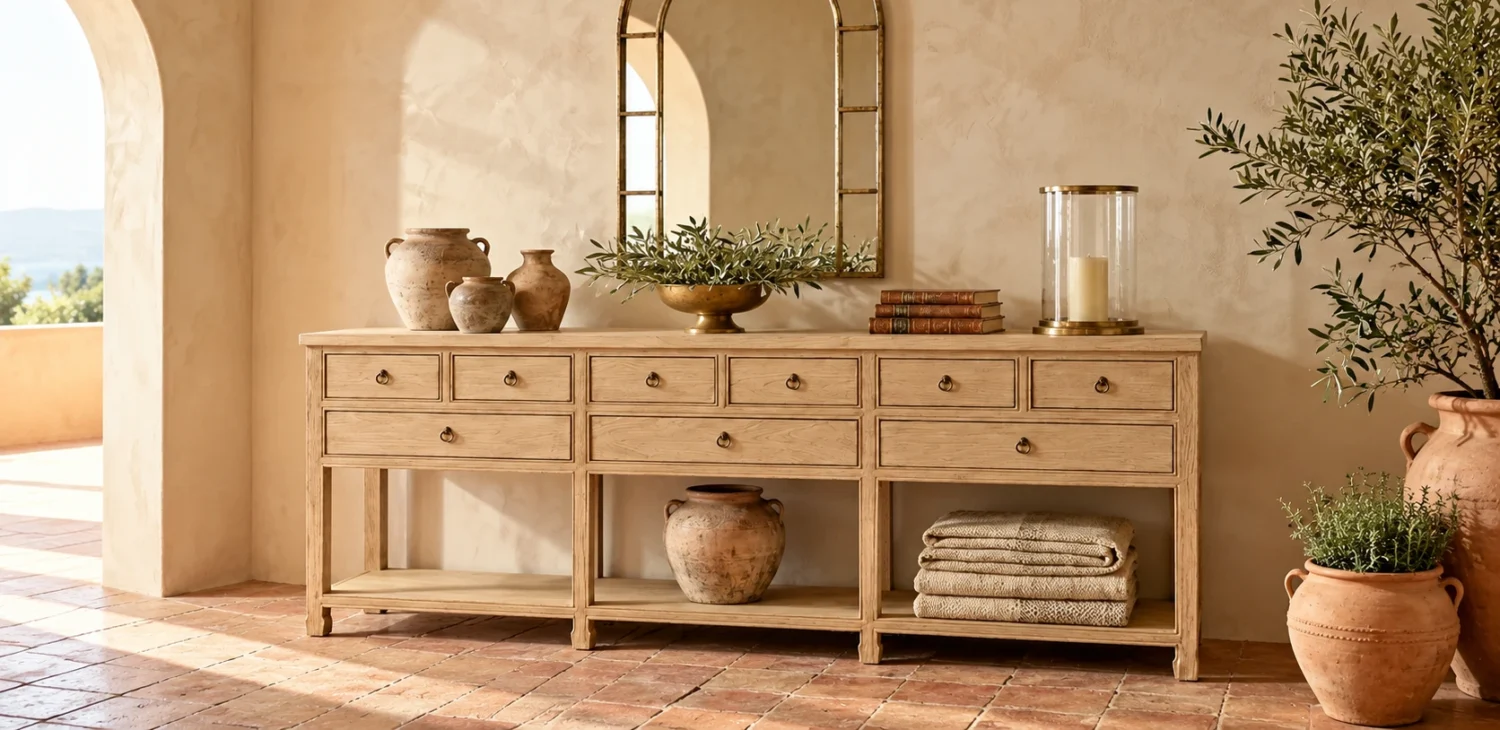

Buying a vintage wooden console isn’t like picking something off a showroom floor. Every piece carries decades of use, and that history is both its appeal and its risk. Knowing what to check before you commit is the difference between ending up with something genuinely worth owning and something that photographs beautifully but wobbles the moment it arrives in your hallway.
The five points below cover what actually matters – wood condition, construction quality, finish, proportions, and authenticity – so you can shop with real confidence.
Assess the Condition of the Wood Before Anything Else
When you’re searching for a vintage wooden console table, the timber’s condition tells you more about long-term value than any price tag. Run your hand across the surface and look for deep splits or cracks running along the grain. Hairline surface cracks are common in aged wood and rarely structural; a crack that travels through a leg or the main apron is a different headache entirely. Check the underside too; sellers rarely restore what buyers can’t easily see. Soft spots, a spongy texture, or a musty smell can all point to moisture damage or old woodworm activity. Neither is automatically a deal-breaker, but both affect what restoration will cost you later.
A piece in genuinely good structural shape just needs cleaning and perhaps a light re-oiling. One hiding serious damage will cost far more to fix than you ever saved on the purchase price. Ring stains, light scratches, or faded patina are usually fine to live with, or relatively simple to address. Uneven patina that’s built up naturally over decades adds character that’s almost impossible to fake. What you want to avoid is damage that compromises stability or has been poorly patched by a previous owner. Filled holes painted over, mismatched timber repairs, or suspiciously fresh stain in one section can all signal that someone tried to bury a problem. Ask the seller directly what they know about the piece’s history; an honest answer, even an incomplete one, tells you a lot.
Understand the Wood Type and How It Affects Durability
Not all timber ages the same way. Knowing what species you’re looking at changes how you care for the piece, and what you can reasonably expect from it over time. Elm, teak, and sheesham are all commonly found in vintage Indian and Asian furniture, each with a distinct grain, weight, and response to humidity. Elm from reclaimed beams, carts, or agricultural structures tends to show extraordinary figuring and holds up well in Australian conditions. Hardwoods as a category resist denting and scratching far better than pine or poplar, which appear in some European vintage pieces and need more careful placement away from heavy traffic areas.
Look at the end grain where it’s visible. Tight, close rings generally indicate slow-grown, dense timber that’s more stable over time; open, wide rings suggest faster growth and a softer structure. Check whether the piece is solid wood throughout or uses veneers over particleboard in structural areas, a legitimate concern with certain mid-century production runs. Solid wood can be repaired indefinitely. Particleboard swells with moisture and doesn’t recover. For a hallway console that might encounter damp coats or wet umbrellas, that distinction matters more than you’d think.
Examine Joinery and Construction Quality
The way a piece is put together reveals more about its expected lifespan than the wood itself does. Traditional joinery – mortise-and-tenon joints, dovetail drawers, wooden pegs – predates strong adhesives, so it was built to be mechanically sound on its own. A console held together this way will outlast most modern furniture without question. Gently press the frame from different angles while it sits on a flat surface. There shouldn’t be any racking, creaking, or visible flex at the joints.
Check the drawer construction if the piece has any. Dovetail joints at the drawer corners are a strong indicator of hand craftsmanship and period authenticity – machines cut straight joints, hands cut dovetails. Drawers should slide smoothly without binding, and drawer bottoms should be solid wood rather than thin plywood or cardboard. Hardware is worth checking separately. Original brass or iron fittings add value, while obviously mismatched or plastic replacement hardware suggests the piece has been through at least one clumsy restoration. But replacements aren’t necessarily a problem if they’re sympathetic – cheap hardware on an otherwise quality piece is the real flag.
Match the Proportions to Your Actual Space
A console that looks perfect in a warehouse or on a seller’s website can feel overwhelming in a narrow hallway or disappear entirely against a feature wall. Before you inspect any piece in person, measure the wall space you’re working with, width, height clearance, and crucially, depth. Console tables range from around 30 centimetres deep to 50 centimetres or more, and that difference matters in a corridor where people need to pass comfortably.
So think about height in relation to how you plan to use the piece. A lower console at around 75 centimetres suits a living room or the space behind a sofa; a taller piece at 90 centimetres or above works better in an entry where you want visual presence and somewhere to drop keys at a natural hand height. Width matters for visual balance too, a very long console in a short hallway reads as an obstacle, while a small piece on a large wall can look like a furniture accident. Bring your measurements to every inspection. It’s a simple step that saves real disappointment.
Look for Genuine Age and Provenance Markers
Authenticity is genuinely difficult to assess without experience, but there are practical checks that help. Consistent wear patterns are one of the strongest signs of real age, look for wear on the front edges of drawers, at the base of legs where they meet the floor, and on surfaces that hands would’ve touched repeatedly over decades. Wear that’s uniform across a surface (evenly sanded or stained) is often artificial; irregular wear concentrated at contact points is typically the real thing.
And older pieces show shrinkage and movement in the timber as it responded to changes in humidity over many years. Slight unevenness in flat surfaces, small gaps in panel joints, or minor twisting in doors and drawers can all be signs of genuine age rather than poor construction. Ask for any provenance the seller can offer, a rough region of origin, an approximate decade, photographs from an earlier owner. You won’t always get a documented history; that’s fine. The truth is, a seller who’s honest about the limits of what they know is a very different situation from one who simply knows nothing and volunteers nothing.
Conclusion
Buying a vintage wooden console well comes down to patience and the right checklist. Assess the timber’s structural health first, understand what species you’re working with, check the joinery carefully, measure your space before you fall in love with a piece, and look for wear patterns that confirm genuine age. A piece that passes all five tests isn’t just furniture, it’s something that’ll hold its character and value for years to come.
You Might Also Like